An itinerary agent for travel designers.
Drengur turns a client email into a checked, client-ready itinerary for your approval. It structures the brief, plans and prices the trip from dated supplier rate sheets, checks every leg and runs quality gates before anything reaches you. A team of agents on APG (Agents Proving Ground) does the work, and nothing is sent without your approval.
The app running
One inquiry
From the client's email to a checked itinerary.
The agent reads the email, plans the trip, prices it from dated rate sheets and checks every leg. The finished PDF waits for you.
- It reads the brief
- Dates, party, places and wishes are pulled out of the email.
- It prices from dated sheets
- Where a price is not on a dated rate sheet, the line stays open for you.
- It runs fifteen quality gates
- Every leg is checked before you see the draft.
- It never sends
- The PDF waits for your approval.
Done: checked on 15 quality gates, PDF approved
Done- Read the email
- Structure the brief
- Plan the trip
- Price from dated rate sheets
- Check every leg
- Wait for you
- Approved
One inquiry, from the client's email to a checked itinerary.
The platform reads the email, structures the brief, plans the trip, prices it from dated supplier rate sheets and checks every leg. A voice pass and fifteen quality gates follow. The finished PDF then waits for you. It is never sent automatically.
Where a price is not on a dated rate sheet, the line is left open for you. The platform does not estimate it.
Demo data. An invented client email moves through eight stages: client email in, intake, itinerary plan, pricing, logistics check, voice pass, quality gates and itinerary PDF. Pricing uses dated supplier rate sheets and leaves a line open rather than inventing a price. The finished PDF waits for the travel designer to approve it and is never sent automatically.
How it works.
Step 1
Capture the brief.
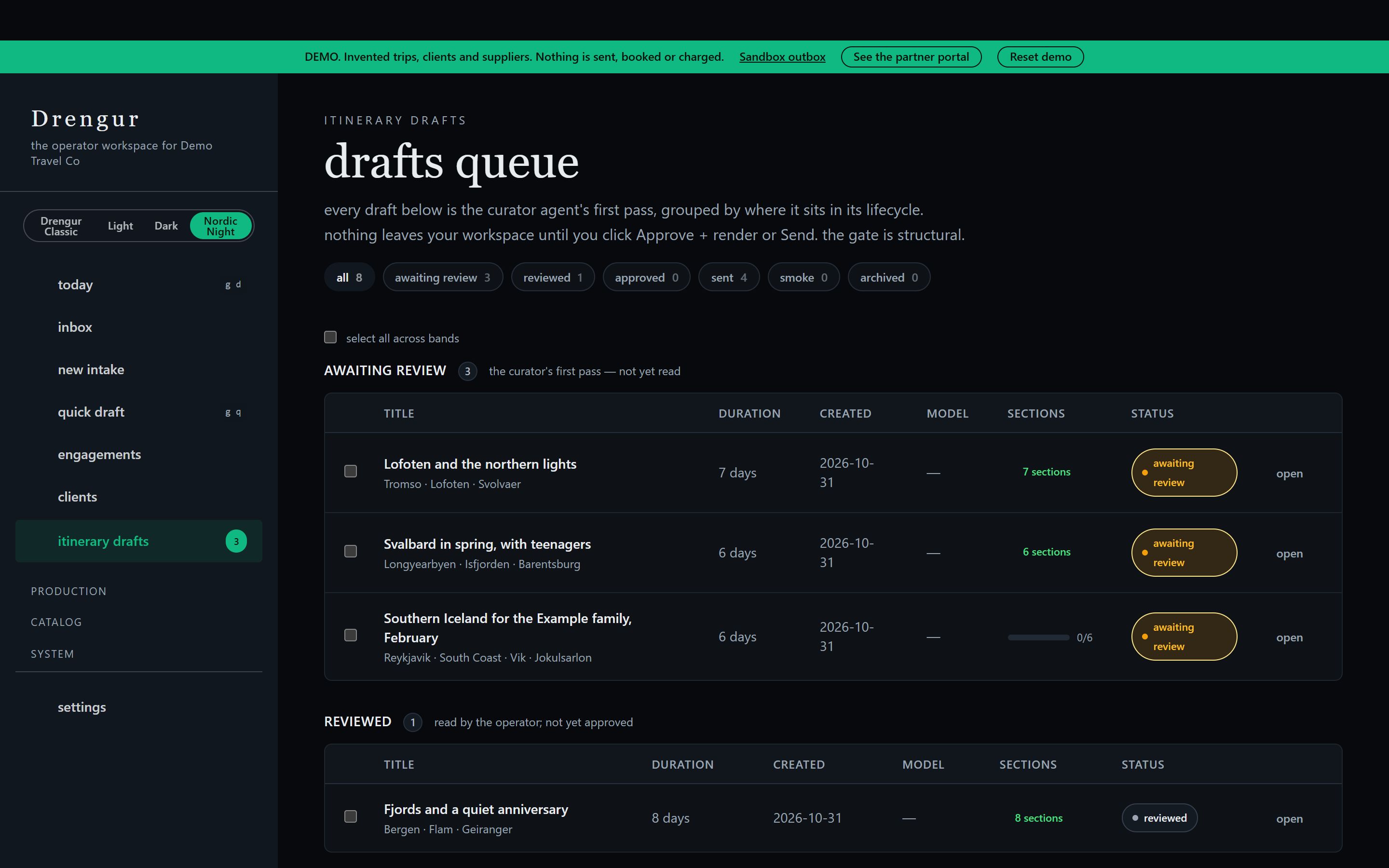
Paste the client's email and the form fills itself in from it. You check what it found before anything is drafted.
Drengur, new intakeDemo data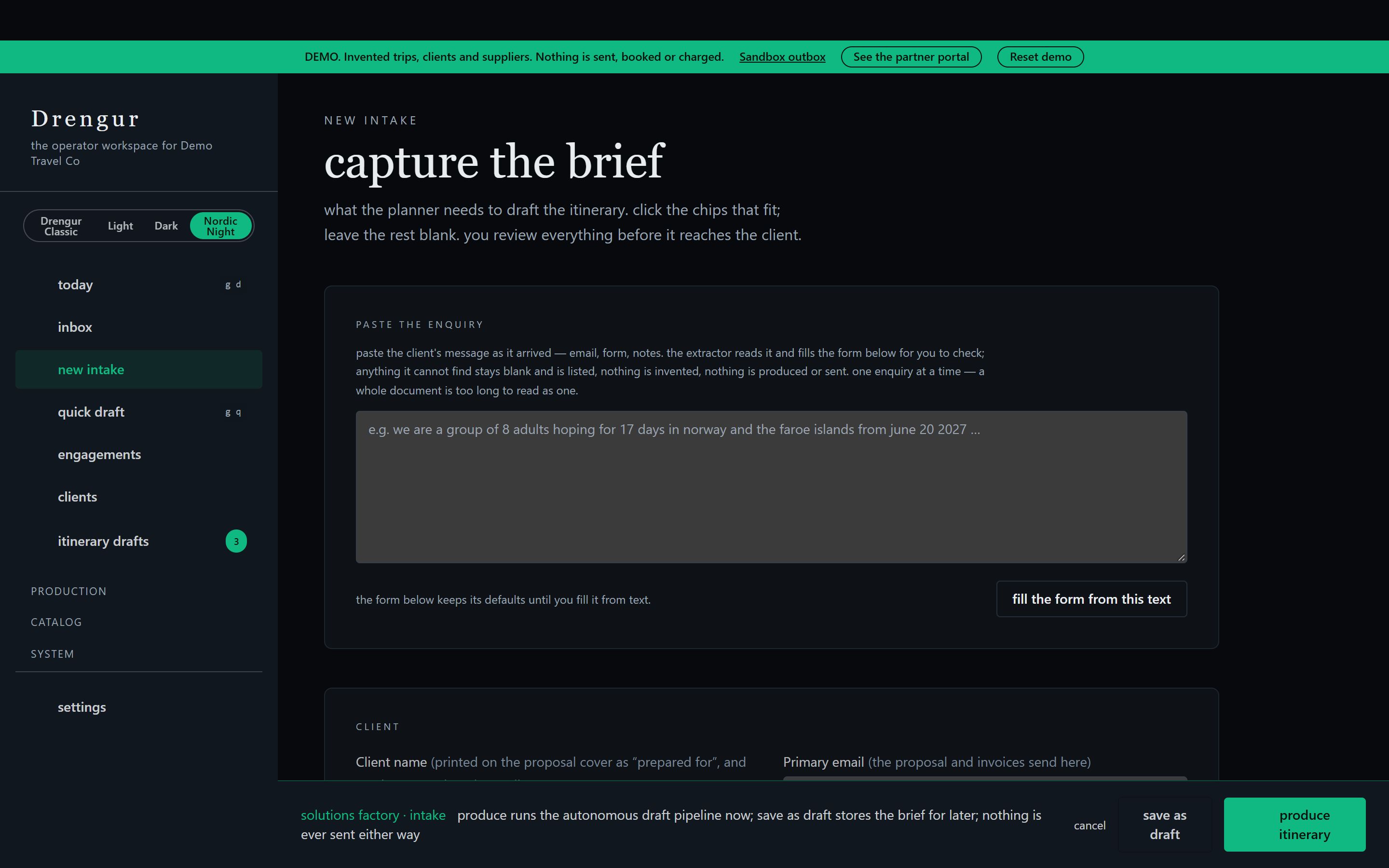
Step 2
Plan the trip.
The planner turns the brief into a structured plan: a spine of days, transport and activity slots, grounded in the vendor catalog. You review and adjust it.
Drengur, itinerary plansDemo data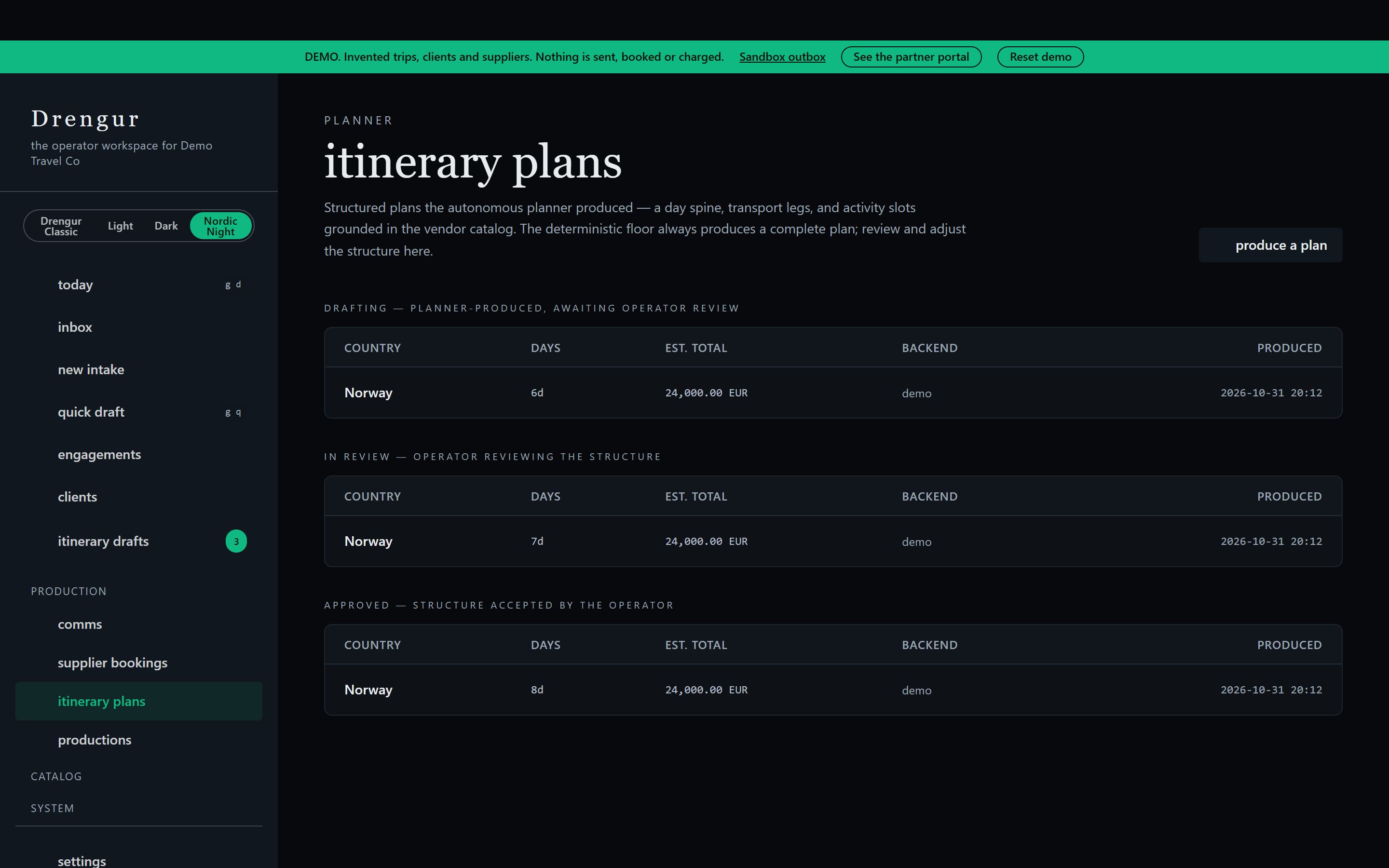
Step 3
Quality control runs before you see it.
An audit checks the draft for client match, geography, routing, lodging, prices and facts. Checks that need judgment are marked for you.
Drengur, auditDemo data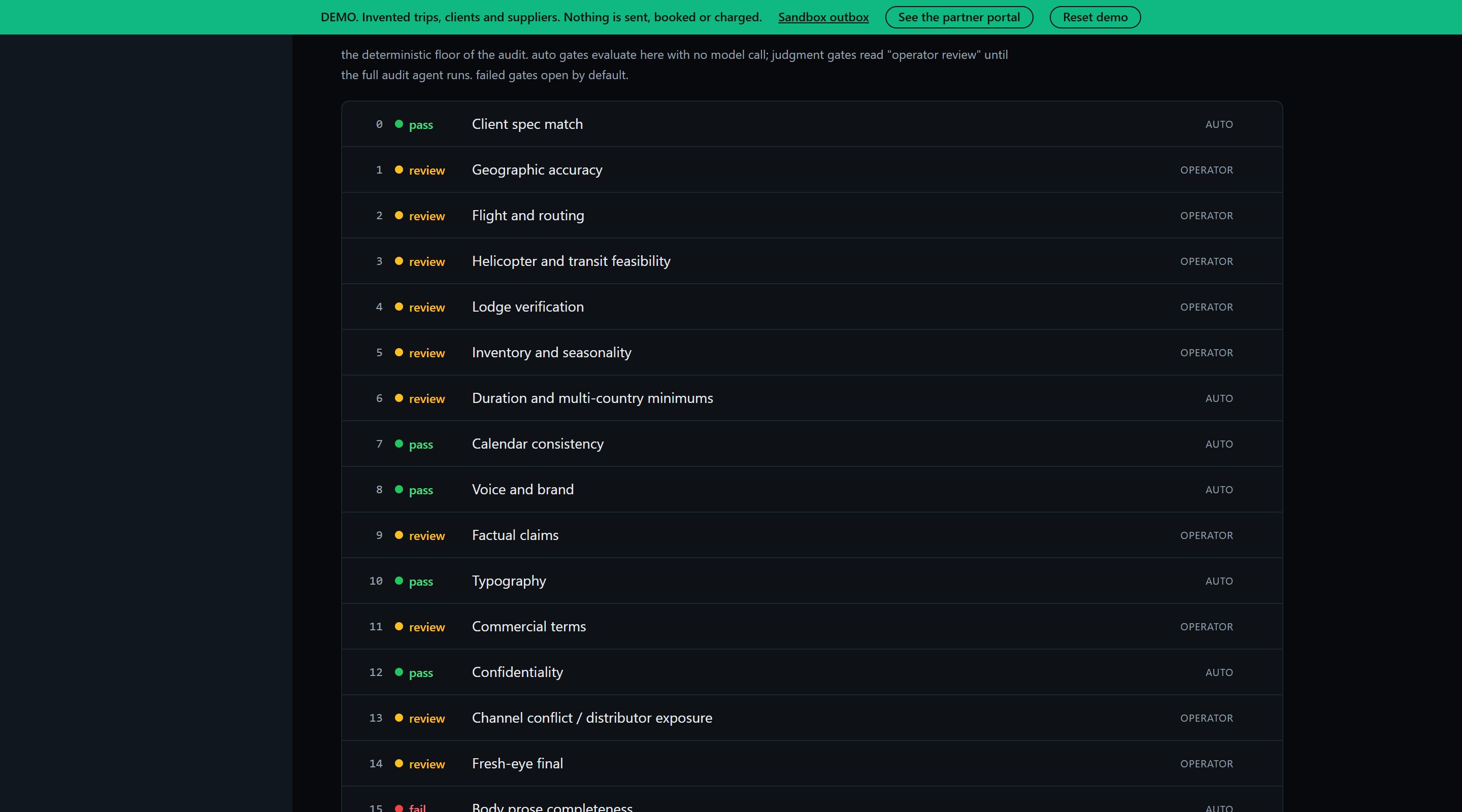
A replay where the quality gates refuse the document.
This is a second run, one the quality gates stop. The platform refuses to render a flawed document, and lists the findings.
- plannerPlan produced, 14 days, three regions.Passed
- distancesLegs measured against the platform's own geography graph.Passed
- curator14 day sections written. Drafted only.Passed
- pricing6 price lines drafted from your dated supplier rate sheets.Passed
- gatesCoverage, feasibility, season and shipping checks.Refused
- documentsThe client PDF is withheld until the gates clear.Not ready
Travel software fits the wrong operator.
Vertical travel software comes in two shapes. One is enterprise-priced and built for tour operators with a procurement department. The other is a generic itinerary builder aimed at retail leisure agencies. Neither fits a travel designer who builds bespoke trips for high-net-worth clients and works through a network of suppliers and distributors.
So the real stack becomes spreadsheets, manual coordination and a website front end. That setup is fragile and hard to audit, and partners and customers struggle to take it seriously.
The work is demanding: bespoke itineraries, supplier relationships, multi-currency money, and confidentiality that has to hold. It needs a platform built around it. A CRM with a travel skin will not do.
What a travel designer needs.
- Lead intake and supplier coordination across the network you work with.
- Distributor liaison for the partners who bring you the business.
- Itinerary curation with a brand-aligned quality audit before anything ships.
- Voice pre-screen on inbound, so the right inquiries reach a human.
- Multi-currency money handled in integer minor units, so no amount ever goes through float arithmetic.
- Stripe Connect agent-of-payee for clean, auditable money movement.
- A 15-gate quality audit every brief passes before it leaves the building.
- Fourteen operational surfaces covering the whole trip-design workflow end to end.
# multi-tenant Django, on infrastructure you control
$ tar xzf solutions-factory-drengur.tar.gz
$ cd solutions-factory-drengur && docker compose up -d
Drengur ready at http://localhost:8000 · agents bound to APG runtime
Eight specialized agents run on APG.
Each runs on your own APG runtime, under its cost caps, health checks and confirm gates. The high-stakes ones, which handle money and outbound briefs, stop for human approval by default.
Lead intake
Turns an inbound inquiry into a structured lead, ready for a coordinator.
Supplier coordinator
Manages the back-and-forth with suppliers across the itinerary.
Distributor liaison
Keeps distributor partners in the loop on the deals they sourced.
Itinerary curator
Assembles the bespoke itinerary against the brand and the budget.
Translation
Renders briefs and correspondence across the languages your clients and suppliers work in.
Quality audit
Runs the 15-gate audit before a brief is allowed out.
Quote and document generation
Produces quotes and the supporting documents a human signs off.
Refund handler
Works the refund path against the integer-minor-unit money plane, gated on approval.
A software fee, with inference itemized.
Self-host
Run the platform on your own infrastructure. You keep the data, pick the jurisdiction and run the backups.
Managed
Flat per workspace, per month. We operate it on infrastructure you authorize.
Inference
Separate and itemized: your own model key, sovereign on your GPU, or SF managed (coming soon).
Built around how a travel designer actually works.
Confidentiality carries real weight in this business. Client identities, supplier terms and money movement sit in your own database, in your jurisdiction, with the audit trail intact. The money plane is integer minor units end to end, so reconciliation is exact.
The platform follows the real work: bespoke itineraries, supplier terms and confidential clients. It is not a generic CRM with a travel skin.
For the travel designer evaluating the platform.
The technical fact sheet, in one place.
- Stack
- Multi-tenant Django. Self-hosted via Docker.
- Money
- Integer minor units throughout; Stripe Connect agent-of-payee. No float arithmetic for money.
- Agents
- Eight specialized agents on your APG runtime, with confirm gates on the high-stakes ones.
- Quality
- A 15-gate quality audit every brief passes before it leaves the building.
- Surfaces
- Fourteen operational surfaces covering the whole trip-design workflow.
- Documentation
- Seven architectural sequence docs and seven operational runbooks.
- Inference
- BYOK, a hosted model you choose (Tier 2) or a local model (Tier 3). SF managed (Tier 1) is coming soon.
- Status
- Multi-tenant data model live; surfaces and agents shipping.
- Anchor metric
- Audited briefs delivered per week, with confidentiality discipline maintained.
How it differs from the two usual routes.
Enterprise travel suites and mid-market operator software are where most travel designers look first. The table compares with the category and names no product.
| Capability | Drengur | Enterprise travel suite | Mid-market operator software |
|---|---|---|---|
| Hosting | Self-host or managed | Vendor cloud | Vendor or hosted |
| Fit | Travel designers, high-net-worth clients | Enterprise tour operators | Mid-market operators |
| Money handling | Integer minor units, Stripe Connect | Configurable | Built in |
| Agents | Eight, on APG | None built in | None built in |
| Quality audit | 15 gates, before every brief | Manual | Manual |
| Data residency | Yours | Vendor cloud | Vendor or hosted |
Where deployments stand today.
APG runs the agents behind our own CRM and Drengur. Drengur runs at a first customer, drafting and rendering client documents under operator review. CRM tenant deployments are under way and none is named yet.
Inference: BYOK (Tier 2), sovereign on your own GPU (Tier 3), SF managed (Tier 1, metered and itemized, coming soon). See Infrastructure.
Turn the next client email into a checked itinerary.
Read the quickstart to self-host, or tell us about your workflow and we will walk it with you.