The CRM where agents do the data entry.
You license it and host it yourself. It is a full CRM with four agents on your own APG (Agents Proving Ground) runtime that keep the pipeline complete. Inference is itemized and runs where you choose.
The app running
A day in the CRM
Follow-ups that write themselves.
Agents find the deals that went quiet and draft the follow-up. You read each one and approve it. Nothing is sent before you do.
- It finds quiet deals
- Deals with no reply for a week are picked out of the pipeline.
- It drafts from the thread
- Each follow-up starts from the last conversation with that contact.
- It waits for you
- A draft stays held until a person approves it.
- It logs the rest
- The notes and the record are filled in, so nobody types them up at 5pm.
Done: 4 follow-ups drafted, approved and sent
Done- Find deals quiet for 7 days
- Read the last thread
- Draft the follow-ups
- Wait for you
- Approved and sent
How it works.
Step 1
See what needs you.
Today lists what waits for your approval and what is due. Each draft is one click to review.
CRM, TodayDemo data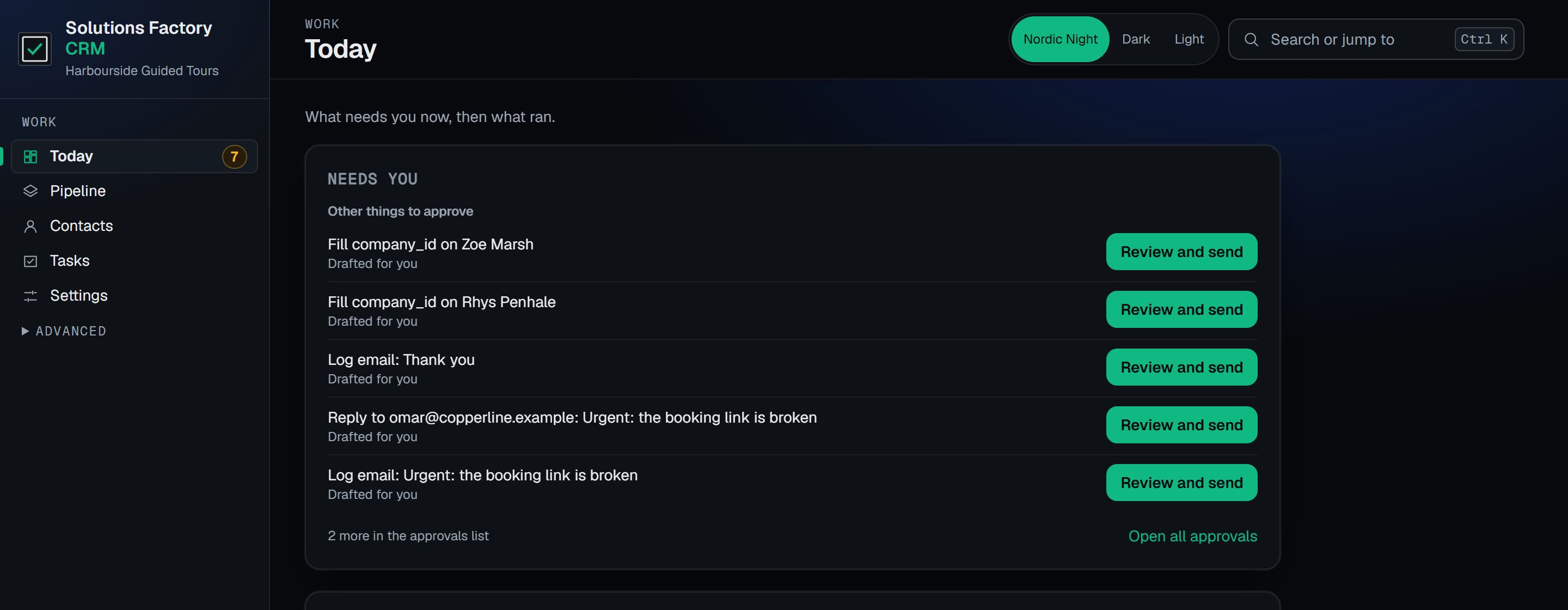
Step 2
Approve in one place.
Drafts and changes wait for your yes. Nothing is sent or changed until you approve it.
CRM, approvalsDemo data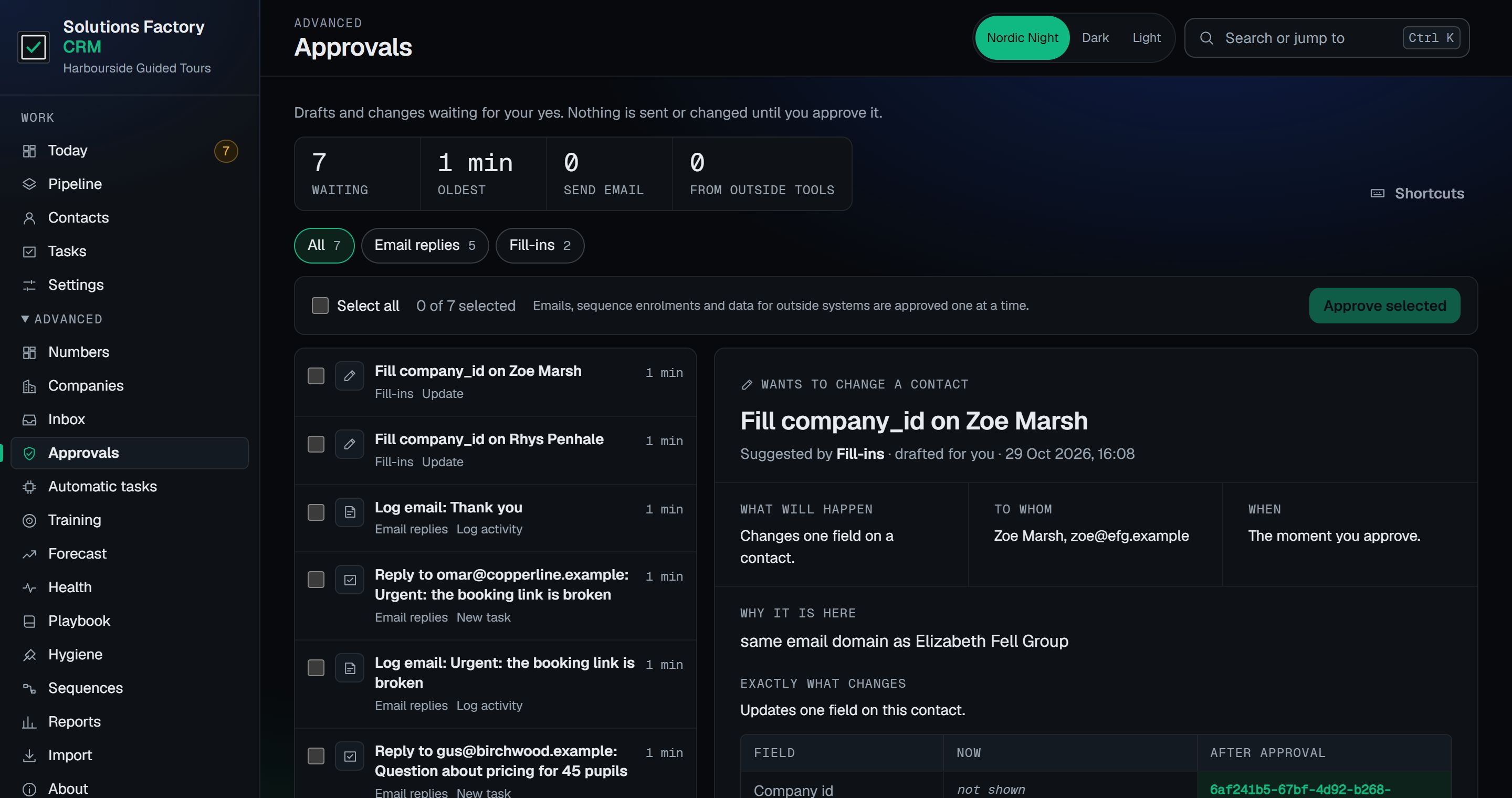
Step 3
Check what the agents did.
Automatic tasks shows the runs, the tokens and the cost of each agent, so the spend is never a surprise.
CRM, automatic tasksDemo data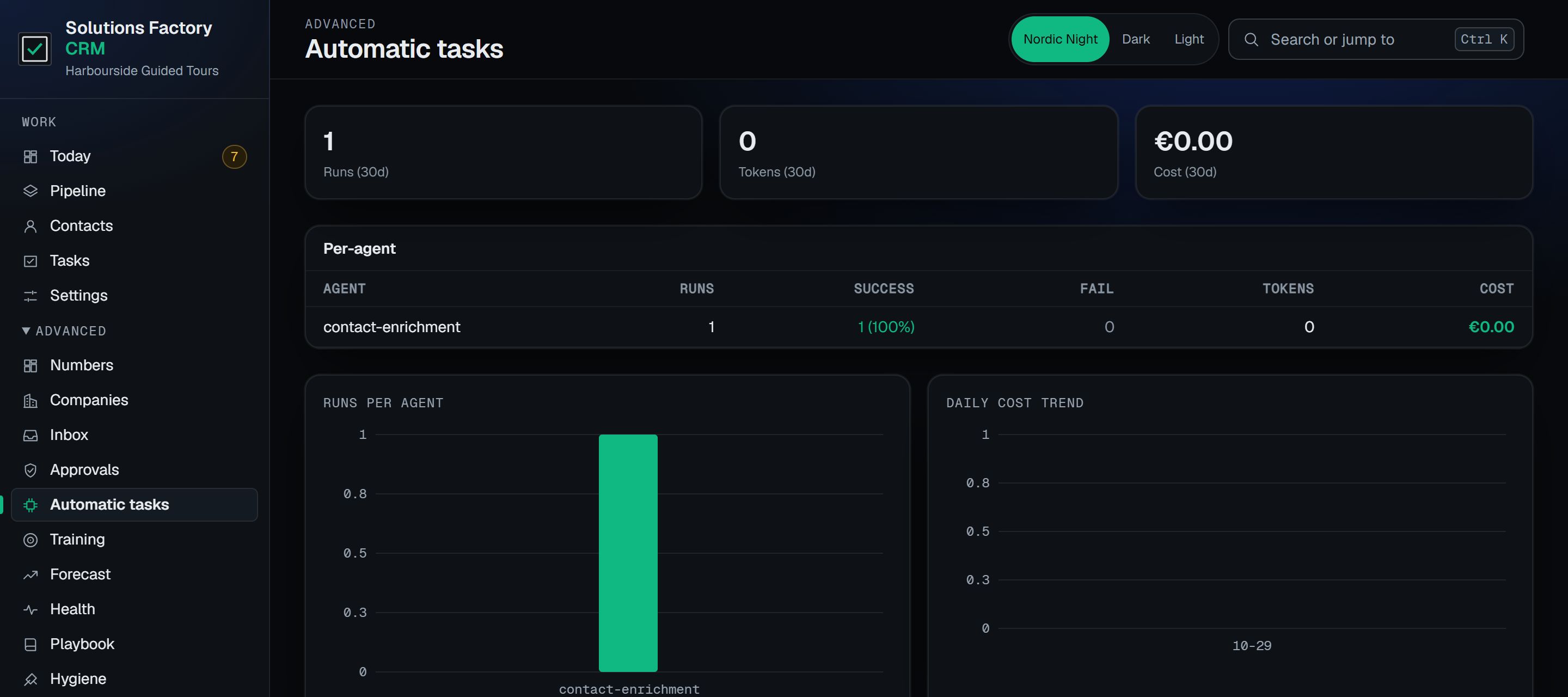
The product, screen by screen.
These are illustrations of the CRM, drawn with invented demo data. The names, companies and amounts are invented.
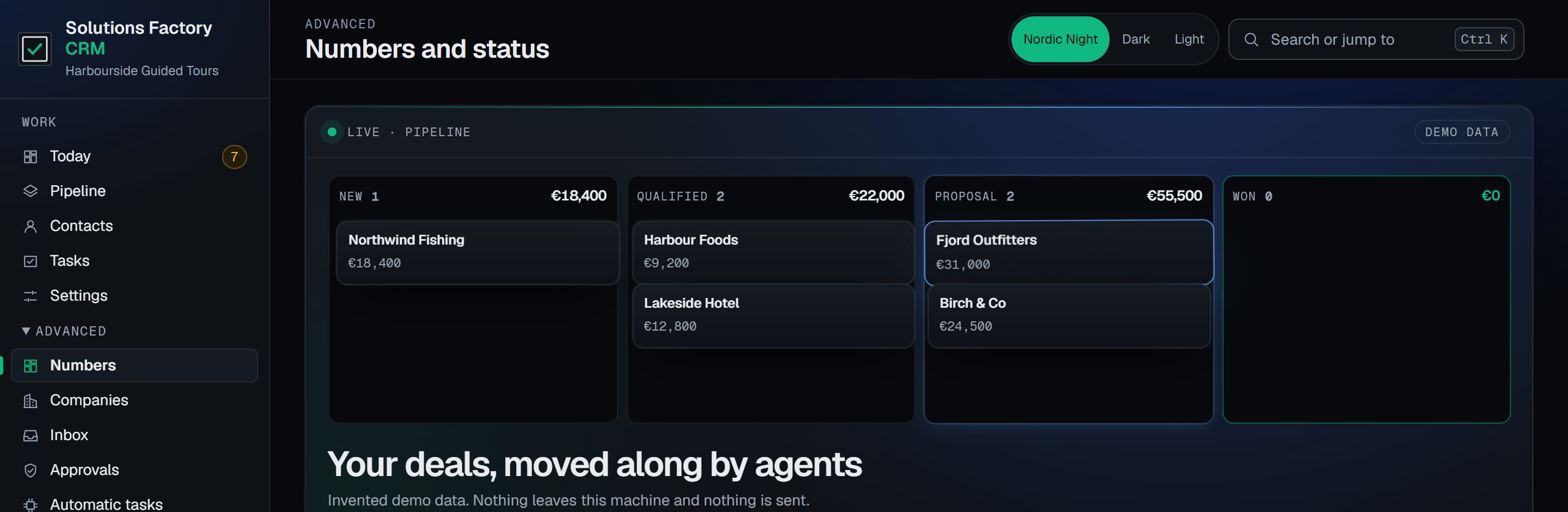
Pipeline
The deals board, with a total for each stage.
Confirm inbox
Agents propose. A person approves, rejects or edits. Nothing is written without a sign-off.
Contact record
A contact with its timeline of meetings, notes and emails, and the deal it is tied to.
Reports
Open value by stage, what was won this month and the win rate.
Data entry is the part nobody does.
Ask any sales manager how many of their CRM records are complete and current, and watch the pause before the answer. The cause is not laziness. Data entry is the least rewarding part of a rep's day, so it slips to 5pm on Friday, or it never happens. The forecast inherits the gaps.
Cloud CRMs answer with an AI tier priced per user per month. Self-hosted open-source CRMs solve data sovereignty, and the manual entry stays manual.
Privacy-sensitive teams carry a second problem. Legal, healthcare and financial-advisory practices often cannot host a client pipeline on a US cloud at all. They need the pipeline on their own infrastructure, in their own jurisdiction, with no exceptions to negotiate.
A full CRM underneath, with agents on top.
The feature set is what a sales team expects, and you host it yourself.
- Contacts and companies with custom fields and tags.
- Pipeline kanban with drag-to-stage and weighted value.
- Activities and tasks tied to every record.
- Reports on pipeline, velocity, and conversion.
- CSV import and export with no row caps.
- Signed webhooks and a full REST API with tokens.
- Public forms that write straight to the pipeline.
- Multi-tenant isolation enforced at three layers.
# your data stays on this machine
$ tar xzf solutions-factory-crm.tar.gz
$ cd solutions-factory-crm
$ docker compose up -d
CRM ready at http://localhost:8080 · agents bound to APG runtime
Four agents run on your APG appliance.
Each agent runs under the same cost ceilings, health checks and operator-confirm gates as everything else on APG. At Tier 2 inference runs on your own key, and at Tier 3 it runs sovereign on your GPU. Tier 1, metered and itemized through us, is coming soon.
The data clerk
Deduplicates, enriches and flags stale records continuously. This is the one that makes the pipeline trustworthy without a rep typing into it.
The inbox triager
Reads what arrives, classifies it against the pipeline and drafts the reply. A person approves before anything sends.
The pipeline auditor
Flags stalled deals, reports what actually moved this week and keeps stage definitions consistent so the forecast means something.
The briefer
Assembles a one-page account brief before the call, out of records you already hold.
Why these agents are graphs.
An agent left in an open loop is asked to keep going until it decides it is done. That is the right shape for exploration and the wrong shape for a pipeline that has to behave the same way every Tuesday.
We draw recurring work as a graph. It has named nodes, declared inputs and outputs, and one edge to the next step. Every node can be tested on its own, replayed against last week's data and pointed at a different model without touching the ones around it. When something goes wrong you get the node that failed, with no long log to read through.
The four agents above are graphs. Where judgment needs room, the loop stays, but only inside a single node with a cost ceiling and a person on the far side of it.
A software fee, with inference itemized.
Self-host
A software fee. You run it on your own infrastructure and hold the database.
Managed
Flat per workspace, per month. We operate it on infrastructure you authorize.
Inference
Separate and itemized: your own model key, sovereign on your GPU, or SF managed per token (coming soon).
Itemized inference and agents that do the data entry. A per-seat plan does not offer that.
Every contact, deal and note sits in your database, in your jurisdiction, under your backup policy. The agents run on your APG appliance, and the inference behind them is a line item you can read. You can move it from metered to sovereign as your privacy needs change.
For the operator evaluating the stack.
The technical fact sheet, in one place.
- Stack
- Node 22 LTS, TypeScript in strict mode, Zod validation at every domain boundary, JWT auth.
- Data plane
- SQLite via node:sqlite. Eight migrations.
- Agents
- Four, running on your APG runtime under its cost ceilings, health checks, and operator-confirm gates.
- Inference
- BYOK, a hosted model you choose (Tier 2) or a local model (Tier 3). SF managed (Tier 1, metered and itemized) is coming soon.
- Frontend
- No build step. It is HTML and vanilla JS, so the deploy artifact is the source.
- License
- Commercial license to the client. Private repository; no open-source grant.
- Deployment
- Docker and docker-compose, plus four platform deploy configs (Coolify, Railway, Render, Fly).
- Integrations
- Full REST API with an OpenAPI 3 spec, signed webhooks, public forms, API tokens, CSV.
- Isolation
- A multi-tenant isolation contract test blocks any cross-tenant read.
- Status
- V1 shipped 2026-05-29. V2 in flight: email integration, workflow rules engine, browser extension, DocuSign, Stripe billing, mobile PWA, accessibility hardening.
How it differs from a cloud CRM.
A plain comparison on the axes that decide it for a cost-pressured, privacy-conscious team. It compares with the category and names no product.
| Capability | Solutions Factory CRM | Cloud CRM | Open-source self-hosted CRM |
|---|---|---|---|
| Hosting | Self-host or managed | Cloud only | Self-host |
| Data residency | Your database, your jurisdiction | The vendor's cloud | Your database, your jurisdiction |
| Pricing model | Software fee plus itemized inference | Per seat, per month | Varies by project |
| Data entry | Four agents on APG | An AI add-on tier | Manual |
| API | REST with OpenAPI 3 | Yes | Varies |
Where deployments stand today.
APG runs the agents behind our own CRM and Drengur. Drengur runs at our first pilot, drafting and rendering client documents under operator review. CRM tenant deployments are under way and none is named yet.
Inference: BYOK (Tier 2), sovereign on your own GPU (Tier 3), SF managed (Tier 1, metered and itemized, coming soon). See Infrastructure.
Self-host the CRM on your own machine.
Download the release, unpack it, bring it up with docker compose and bind its agents to your own APG runtime. Or tell us about a managed deployment.